AI's Memory Hunger: How Surging DRAM Prices Are Reshaping the Tech Landscape and Your Next PC Purchase
The insatiable demand for AI data centers is driving an unprecedented surge in DRAM memory prices, with a 90% increase in Q1 2026 alone. This global shortage is already impacting consumer tech, as evidenced by Apple discontinuing its entry-level Mac Mini. Experts predict significant price hikes for PCs and other devices, signaling a fundamental shift in the tech industry's supply chain and pricing models. This article explores the ripple effects of AI's memory appetite on the broader market.
The digital world is currently experiencing a seismic shift, one driven by the insatiable appetite of Artificial Intelligence for raw computing power. At the heart of this transformation lies DRAM (Dynamic Random-Access Memory), the crucial component that allows computers to perform tasks quickly. What was once a predictable, cyclical market has been thrown into disarray, with memory prices surging by an astonishing 90% in Q1 2026 alone. This unprecedented spike, fueled almost entirely by the explosive growth of AI data centers, is not just an industry footnote; it's a fundamental reordering of the tech landscape, with direct and tangible consequences for consumers, businesses, and the future of computing.
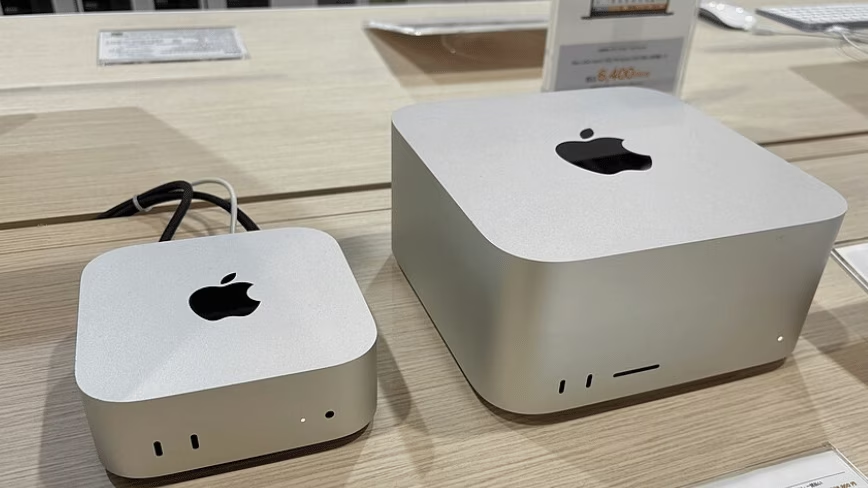
Evidence of this disruption is already manifesting in the consumer market. Apple, a company renowned for its meticulous supply chain management and strategic pricing, recently made a telling move: discontinuing the $599 Mac Mini with 256GB of storage. The entry-level offering now starts at $799, boasting 512GB. While this might seem like a simple product refresh, it's a direct consequence of the escalating cost of memory. The decision underscores a stark reality: even tech giants are not immune to the economic forces unleashed by AI's relentless demand for DRAM.
The AI Gold Rush: A New Era for Memory Demand
The current memory crisis is unlike previous cycles of supply and demand. Historically, DRAM price fluctuations were often tied to PC and smartphone sales, with periods of oversupply leading to price drops and vice versa. However, the advent of generative AI and large language models (LLMs) has introduced a new, dominant player into the market: AI data centers. These colossal computing hubs, essential for training and running complex AI models, require vast quantities of high-bandwidth, high-capacity DRAM. Their demand is not just significant; it's transformative.
According to industry analysts, AI servers now consume an astounding 23% of the global memory wafer output. This figure is projected to grow even further, potentially reaching 30% or more in the coming years. To put this into perspective, a single advanced AI server can demand hundreds of gigabytes, if not terabytes, of specialized DRAM, far exceeding the requirements of conventional servers or consumer devices. This unprecedented demand has created a bottleneck, as memory manufacturers struggle to retool their production lines to meet the specific, high-performance needs of AI applications. The shift isn't merely about quantity; it's also about the type of memory. High-Bandwidth Memory (HBM), specifically designed for AI accelerators, commands a premium and requires complex manufacturing processes, further straining resources.
Ripple Effects: From Data Centers to Your Desktop
The impact of this AI-driven memory shortage is far-reaching. While AI data centers are the primary beneficiaries of the available DRAM supply, the ripple effect is being felt across the entire electronics industry. PC manufacturers are particularly vulnerable. With a significant portion of DRAM being diverted to AI, the supply available for traditional PCs, laptops, and even gaming consoles is shrinking, leading to inevitable price increases. Analysts predict that PC prices could climb by 10-20% in the near future, making consumer electronics significantly more expensive.
This isn't just about the raw cost of components; it's also about strategic allocation. Memory manufacturers are prioritizing their most lucrative customers – the hyperscalers and AI companies – who are willing to pay top dollar for guaranteed supply. This leaves smaller players and consumer electronics manufacturers scrambling for residual stock, often at inflated prices. The situation creates a challenging environment for innovation in other sectors, as the cost of essential components rises, potentially stifling the development of new, affordable devices.
Navigating the New Normal: Strategies and Challenges
For consumers, the immediate future means potentially higher prices for new devices and perhaps a longer lifespan for existing ones. For businesses, especially those in the PC and consumer electronics space, it means re-evaluating supply chain strategies, exploring alternative memory technologies, or absorbing higher costs, which will ultimately be passed on to the end-user. Memory manufacturers, while enjoying record profits, face the immense challenge of scaling production to meet both AI and traditional demands simultaneously. This requires massive capital investments in new fabrication plants and research into more efficient manufacturing processes.
One potential long-term solution lies in diversification of memory types and increased investment in R&D for next-generation memory technologies. Companies are exploring alternatives to traditional DRAM, such as MRAM (Magnetoresistive RAM) or advanced packaging techniques that can squeeze more performance out of existing silicon. However, these solutions are years away from widespread commercial adoption. In the interim, the industry will likely see continued volatility and strategic partnerships forming between memory suppliers and key AI players to secure supply.
The Future of Tech: A More Expensive, AI-Centric World
The current DRAM crisis is a stark reminder of how interconnected the technology ecosystem has become. The rapid ascent of AI, while promising immense innovation, comes with significant economic consequences. The $599 Mac Mini's demise is more than just a product change; it's a harbinger of a future where foundational computing components are increasingly scarce and expensive, driven by the voracious needs of artificial intelligence.
As we move forward, the tech industry will need to grapple with these new realities. Balancing the demands of cutting-edge AI with the need for affordable, accessible consumer technology will be a critical challenge. The era of cheap, abundant memory may well be behind us, replaced by a landscape where every gigabyte of DRAM is a precious commodity. This shift will undoubtedly influence product design, pricing strategies, and ultimately, the accessibility of technology for billions worldwide, marking a significant inflection point in the digital age. The question is not if prices will rise, but by how much, and for how long, as the world races to build the infrastructure for an AI-powered future.
Stay Informed
Get the world's most important stories delivered to your inbox.
No spam, unsubscribe anytime.
Comments
No comments yet. Be the first to share your thoughts!