Medieval Cannonball Cache Rewrites History: Belgium's Unprecedented Discovery
A remarkable discovery in Nieuwpoort, Belgium, has unearthed approximately 450 medieval cannonballs, dating between 1350 and 1600 A.D. This unprecedented find offers a rare glimpse into early gunpowder warfare and the strategic importance of the region during a tumultuous period. Archaeologists believe the cache could be a unique insight into a pivotal era of military technology and trade. The discovery promises to reshape our understanding of medieval European conflict and armaments.
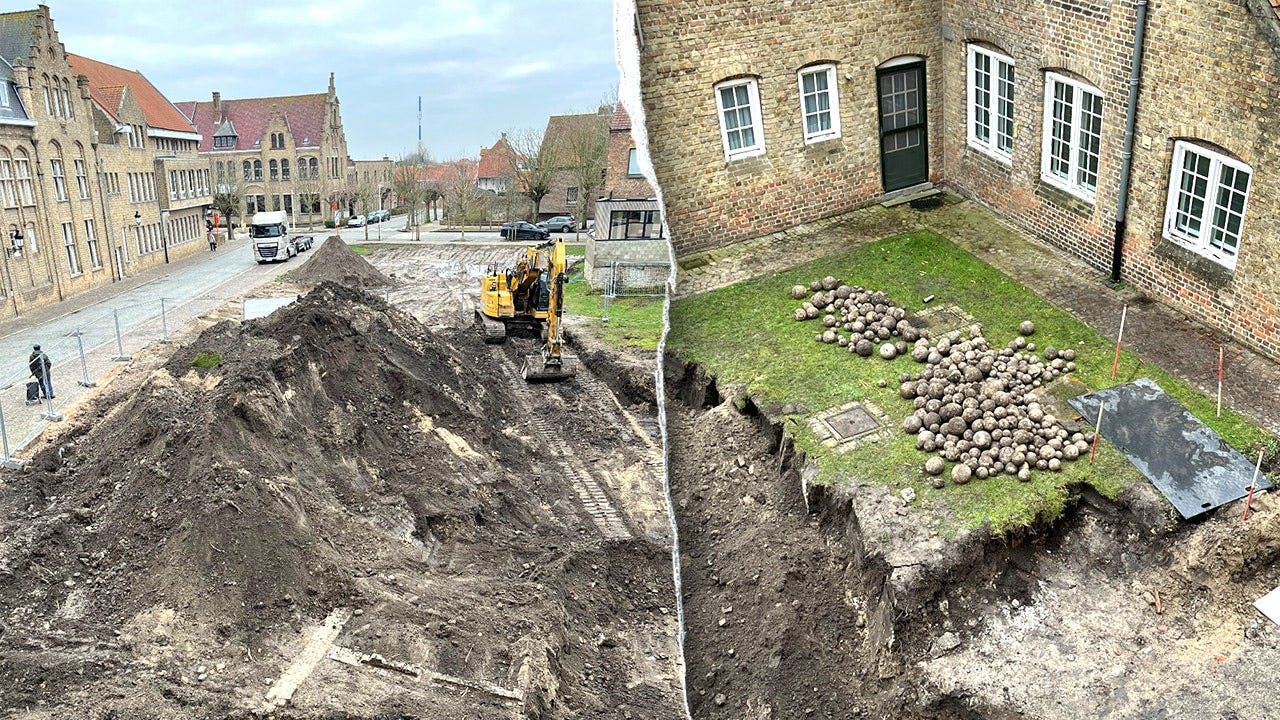
In a quiet corner of Nieuwpoort, Belgium, beneath what was destined to become an administrative center, archaeologists have stumbled upon a discovery that reverberates with the thunder of forgotten battles. A massive cache of some 450 medieval cannonballs, dating from the tumultuous period between 1350 and 1600 A.D., has been unearthed, sending ripples of excitement through the historical and archaeological communities. This isn't merely an interesting find; it's potentially a first-of-its-kind discovery that promises to fundamentally alter our understanding of early gunpowder warfare, trade routes, and the strategic significance of the Low Countries during a pivotal era.
The Unearthing: A Glimpse into the Past
The discovery was made during preliminary excavations ahead of a new construction project, a common scenario where modern development uncovers ancient secrets. What began as routine archaeological work quickly escalated into a find of extraordinary proportions. The sheer quantity of the cannonballs – nearly half a thousand – is what sets this discovery apart. While individual cannonballs or smaller caches have been found before, a collection of this magnitude, spanning such a specific and critical period, is virtually unheard of. The cannonballs vary in size, suggesting they were intended for different types of artillery, from smaller field pieces to larger siege cannons. This diversity hints at a sophisticated understanding of artillery deployment and logistics, even in the nascent stages of gunpowder technology.
The period between 1350 and 1600 A.D. was a transformative epoch in European history, marked by profound shifts in military strategy and technology. The introduction and gradual refinement of gunpowder weapons revolutionized warfare, rendering traditional fortifications and knightly combat increasingly obsolete. This cache thus serves as a tangible link to that revolution, offering direct evidence of the scale at which these new weapons were being produced and potentially stockpiled. The location, Nieuwpoort, a coastal town with a rich maritime history and strategic importance, further amplifies the significance of the find. Throughout the late Middle Ages and early modern period, control of coastal towns like Nieuwpoort was crucial for trade, defense, and projecting power across the North Sea.
Historical Context: A Crucible of Conflict
To fully appreciate the weight of this discovery, one must delve into the historical backdrop against which these cannonballs were forged and potentially used. The late 14th to the 16th centuries in Europe were characterized by near-constant conflict. Key events and periods include:
* The Hundred Years' War (1337-1453): Though primarily fought between England and France, its ripple effects were felt across Western Europe, driving innovations in military technology, including early artillery. * The Burgundian Wars (mid-15th century): The Duchy of Burgundy, which included much of modern-day Belgium, was a major power, often embroiled in conflicts that demanded advanced weaponry. * The Dutch Revolt (Eighty Years' War, 1568-1648): This protracted struggle for independence from Spanish rule saw extensive use of artillery in sieges and naval engagements. Nieuwpoort itself was the site of a major battle in 1600, just at the tail end of the estimated date range for these cannonballs.
The presence of such a large cache suggests several possibilities: it could have been a munitions depot for a garrison, a storage facility for a major military campaign, or perhaps even a lost shipment intended for a specific siege or battle. The fact that they were found together, rather than scattered, points towards an organized storage or transport event. Analyzing the composition of the iron, the manufacturing techniques, and any associated artifacts could provide crucial clues about their origin and intended use. Were they locally produced, or imported from major arms manufacturing centers like Liège or Germany?
Expert Analysis and Implications
Archaeologists and historians are now faced with the monumental task of meticulously analyzing each cannonball. Dr. Elara Vance, a leading expert in medieval military history at the University of Ghent, commented on the find: "This is an absolutely extraordinary discovery. The sheer volume alone is remarkable, but the dating places it squarely within the period of the gunpowder revolution. It offers an unparalleled opportunity to study the evolution of artillery projectiles, their manufacturing processes, and the logistical challenges of supplying armies in the late medieval and early modern periods." She added, "We rarely get such a clear snapshot of military materiel from this era. It could tell us much about the strategic thinking of commanders and the economic infrastructure supporting warfare."
Further analysis will likely involve:
* Metallurgical studies: To determine the iron composition, origin of the ore, and casting techniques. * Typological classification: To categorize cannonballs by size, weight, and potential use (e.g., anti-personnel, anti-fortification). * Contextual archaeology: Examining the surrounding soil, any remnants of containers, or other associated artifacts that could shed light on how they were stored or lost.
The implications extend beyond military history. Such a large cache would have represented a significant investment of resources. The iron itself, the skilled labor for casting, and the logistical effort to transport them speak volumes about the economic capacity and priorities of the power that amassed them. It could also provide insights into trade networks, as Nieuwpoort was a prominent port. If the iron was sourced from afar, it highlights the international nature of arms supply even then.
A Window into Early Modern Warfare
This discovery is more than just a collection of old metal; it's a tangible link to a pivotal moment in human history – the transition from an era dominated by cold steel to one defined by fire and smoke. The cannonballs represent the cutting edge of military technology of their time, instruments of destruction that reshaped political landscapes and redefined the art of war. They are silent witnesses to the ambitions of princes, the struggles of nations, and the untold lives affected by the advent of gunpowder.
The find in Nieuwpoort serves as a powerful reminder of the destructive power of human ingenuity and the constant evolution of conflict. It underscores the fact that even in an age of advanced weaponry, the roots of modern warfare lie deep in the past, in the very period these cannonballs represent. As archaeologists continue their work, the stories these artifacts hold will slowly be pieced together, offering new narratives and challenging existing assumptions about medieval Europe.
The Future of the Find
Once fully documented and conserved, these cannonballs will undoubtedly become a centerpiece of historical study and public exhibition. They offer a unique educational opportunity to engage with a critical period of history, bringing the abstract concepts of medieval warfare to life. The research stemming from this discovery will contribute significantly to academic discourse, potentially leading to new theories about the scale of early artillery production and deployment. For Nieuwpoort, it solidifies its place not just as a modern administrative hub, but as a site of profound historical resonance, a place where the echoes of ancient cannons can still be heard.
This unprecedented cache is a testament to the enduring power of archaeological discovery to illuminate the past, providing not just artifacts, but profound insights into the human story. It reminds us that history is not static; it is constantly being rewritten, one shovel-full at a time, often in the most unexpected places.
Stay Informed
Get the world's most important stories delivered to your inbox.
No spam, unsubscribe anytime.
Comments
No comments yet. Be the first to share your thoughts!