Bitcoin's $40K Bear Case: A Statistical Anomaly or Looming Reality?
Despite recent gains, some observers remain bearish on Bitcoin, fearing a drop to $40,000. However, mean-reversion models suggest such a decline would be an extreme statistical outlier, placing it in the 0.4th percentile of market corrections. This analysis delves into the data, historical context, and expert opinions to assess the likelihood of such a severe downturn and its implications for the crypto market.
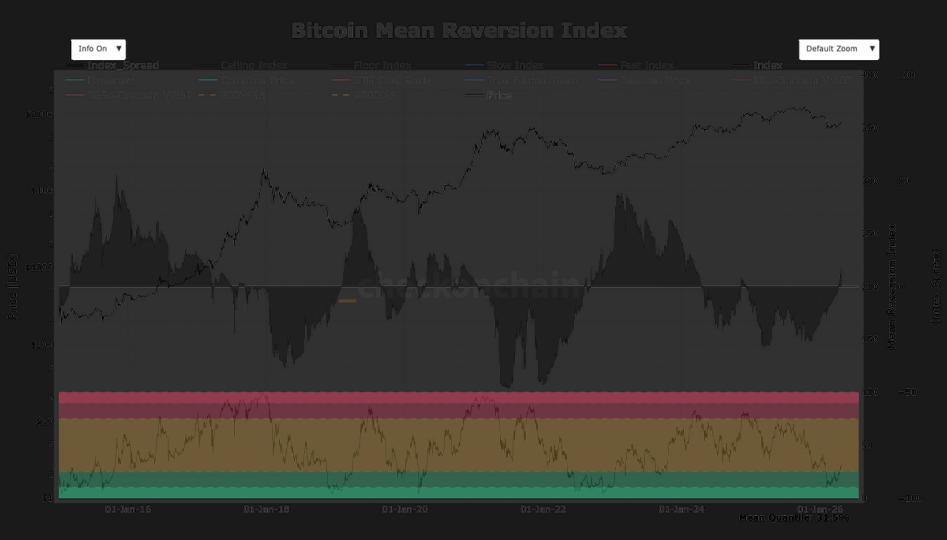
The world of cryptocurrency is no stranger to volatility, but even seasoned investors are scrutinizing recent Bitcoin movements with a mix of hope and trepidation. Despite Bitcoin's (BTC) recent surge—a nearly 15% gain this month—a lingering unease persists among some market observers. The specter of a bear market, which many believe began in October, continues to cast a long shadow, especially given that BTC remains 40% below its record highs. While a return to the $40,000 mark is a bearish target for some, a deeper dive into market analytics suggests such a scenario would be an extraordinary event, challenging historical patterns and data-driven predictions.
The Unprecedented Nature of a $40K Drop
Mean-reversion models, a cornerstone of financial analysis, provide a powerful lens through which to view market movements. These models operate on the principle that asset prices, over time, tend to revert to their historical average or trend. When applied to Bitcoin, the data paints a compelling picture: a drop to $40,000 would not merely be a significant correction but a historic outlier. According to these models, such a decline would represent a 0.4th percentile event. To put this into perspective, it implies that only 0.4% of all historical market corrections have been this severe or worse. This statistical rarity immediately raises questions about the validity of such bearish forecasts, suggesting they might be based more on sentiment than on robust quantitative analysis.
Historically, Bitcoin has experienced dramatic price swings, but even its most brutal bear markets have typically adhered to certain statistical boundaries. The current analysis suggests that a move to $40,000 would break significantly from these established norms. It would imply a level of market capitulation and sustained selling pressure that is almost unprecedented for BTC, especially considering its growing institutional adoption and maturing market infrastructure. This isn't to say that market anomalies don't occur, but their statistical improbability warrants careful consideration.
Understanding Mean-Reversion and Bitcoin's Cycles
Mean-reversion is a fundamental concept in finance, often used to identify overbought or oversold conditions. For Bitcoin, its price history is characterized by distinct halving cycles and periods of rapid expansion followed by significant corrections. These cycles, while volatile, often exhibit a predictable pattern of returning to a long-term growth trend. The 200-week moving average (200WMA) is a widely respected indicator in crypto analysis, often serving as a key support level in bear markets and a benchmark for long-term health. A move to $40,000 would likely breach several critical long-term support levels, including the 200WMA, which currently sits considerably higher.
This indicator has historically acted as a strong floor during major corrections, providing a bounce point for subsequent rallies. The fact that a $40,000 price point would fall well below this historical support level further underscores the extreme nature of such a prediction. While past performance is not indicative of future results, ignoring such a consistent historical pattern would be imprudent. Analysts often look at standard deviations from the mean to gauge the extremity of price movements. A 0.4th percentile event suggests a deviation far beyond typical market fluctuations, implying a systemic shock or a complete paradigm shift in investor behavior that is not currently evident.
The Current Market Landscape and Counterarguments
Despite the statistical improbability, proponents of the $40,000 bear case often point to several factors. These include: * Macroeconomic headwinds: High inflation, rising interest rates, and geopolitical instability could dampen investor appetite for risk assets like Bitcoin. * Regulatory uncertainty: Increased scrutiny from global regulators could create FUD (fear, uncertainty, doubt) and trigger sell-offs. * Whale movements: Large institutional holders or early adopters could decide to take profits, leading to significant downward pressure. * Technical analysis patterns: Some technical indicators might suggest further downside, though these often conflict with long-term fundamental and statistical models.
However, counterarguments are equally compelling. The spot Bitcoin ETF approvals in the U.S. have ushered in a new era of institutional accessibility, bringing fresh capital and legitimacy to the asset class. Major financial institutions are now offering Bitcoin exposure to their clients, a development that was unthinkable just a few years ago. Furthermore, the upcoming Bitcoin halving event in 2024 is historically a bullish catalyst, reducing the supply of new Bitcoin and often preceding significant price appreciation. The narrative of Bitcoin as digital gold and a store of value continues to strengthen, attracting investors seeking inflation hedges and portfolio diversification.
Implications for Investors and the Road Ahead
For investors, understanding these dynamics is crucial. While it's wise to prepare for various scenarios, including downside risk, placing too much emphasis on an extreme outlier prediction can lead to missed opportunities or panic selling. The data suggests that a $40,000 Bitcoin would signify a market event far beyond typical corrections, implying a fundamental breakdown rather than a cyclical downturn. Investors should focus on long-term trends, fundamental developments, and risk management rather than succumbing to fear-driven narratives based on improbable outcomes.
The current market environment is complex, influenced by a confluence of macro factors, technological advancements, and evolving regulatory landscapes. Bitcoin's journey has always been characterized by resilience and innovation. While corrections are an inherent part of its volatile nature, the statistical evidence strongly suggests that a catastrophic drop to $40,000 would be an anomaly of historic proportions. As the market matures and institutional adoption grows, the likelihood of such extreme deviations from its long-term growth trajectory diminishes. The focus should remain on Bitcoin's role as a transformative technology and a burgeoning asset class, navigating its inherent volatility with a data-informed perspective and a long-term vision.
In conclusion, while caution is always warranted in financial markets, the data-driven analysis of mean-reversion models presents a strong case against the extreme bearish target of $40,000 for Bitcoin. Such a price point would represent an event so rare as to be almost unprecedented, challenging the very statistical fabric of its market cycles. Investors are encouraged to look beyond short-term anxieties and consider the broader historical context and the ongoing evolution of the crypto ecosystem. The path forward for Bitcoin is likely to involve continued growth, albeit with its characteristic volatility, rather than a descent into an statistically improbable abyss.
Stay Informed
Get the world's most important stories delivered to your inbox.
No spam, unsubscribe anytime.
Comments
No comments yet. Be the first to share your thoughts!