DJI's Dual Dilemma: How Geopolitical Tensions Ground the World's Drone Leader
DJI, the undisputed leader in the global consumer drone market, finds itself in an unprecedented bind. Facing simultaneous bans from both Beijing and Washington, the company's future and the broader drone industry are at a critical crossroads. This article explores the intricate geopolitical forces at play, the implications for innovation, and what these restrictions mean for global technology supply chains.
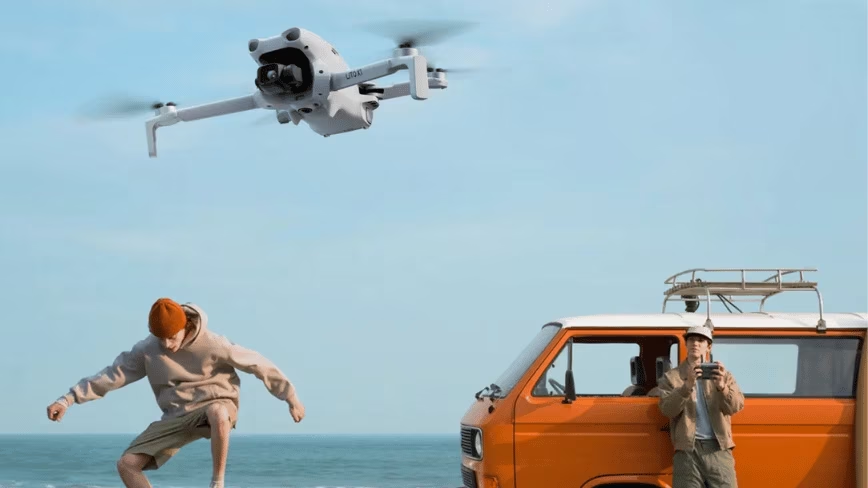
In an era defined by technological advancement and geopolitical friction, even the most dominant industry players can find themselves caught in the crossfire. Such is the fate of DJI, the Shenzhen-based drone manufacturer that has, for years, commanded an astonishing 80% of the global consumer drone market. Once a symbol of China's innovative prowess and a global success story, DJI now faces a dual dilemma: it is effectively banned from selling its products in both its home capital, Beijing, and the United States, its largest overseas market. This unprecedented situation, stemming from divergent national security concerns, threatens to ground the company that pioneered the very concept of accessible aerial photography and videography, reshaping industries from agriculture to entertainment.
The Unfolding Crisis: Bans from Both Sides
The regulatory hammer first fell in the United States. In December 2023, the Federal Communications Commission (FCC) blocked new DJI products from entering the US market, citing national security concerns. This move was not entirely unexpected, building on years of escalating tensions and accusations from Washington regarding potential data espionage and control by the Chinese government. US officials have long expressed worries that DJI drones, with their sophisticated mapping and data collection capabilities, could be exploited for intelligence gathering, particularly given China's national intelligence laws that compel companies to cooperate with state security efforts. The US Department of Defense had already placed DJI on a blacklist, and various government agencies had been prohibited from purchasing or using DJI drones. The FCC's decision solidified a de facto ban on new products for the broader consumer and commercial markets, effectively cutting off a vital revenue stream and market for DJI.
Then, in a move that blindsided many, Beijing followed suit. From May 1, 2026, China’s capital city will ban all drone sales, a decision framed around public safety and security concerns. While the specific wording of the ban targets 'all drone sales,' the implications for DJI are profound. To be restricted from selling in one's own capital, a major economic and technological hub, adds a layer of complexity and irony to DJI's predicament. This domestic restriction, coming after years of the Chinese government promoting its tech champions, signals a potential shift in Beijing's priorities, perhaps prioritizing internal security and control over the global market dominance of its private enterprises, or even a strategic move to foster domestic competitors in a more controlled environment. The cumulative effect of these two bans creates an existential challenge for DJI, forcing it to navigate a drastically shrinking addressable market and a fractured global supply chain.
Geopolitical Chessboard: Data Security vs. Economic Dominance
The core of this international standoff lies in the escalating tech rivalry between the US and China, particularly concerning data security and technological sovereignty. For Washington, the concern is clear: any technology with data transmission capabilities originating from a rival state, especially one with a non-democratic government, represents a potential national security risk. The fear is that sensitive data – from critical infrastructure mapping to personal user information – could be accessed or controlled by the Chinese Communist Party. This narrative has been consistently applied to other Chinese tech giants like Huawei and TikTok, with similar restrictions and calls for divestment.
Beijing's rationale, while officially citing public safety, can be interpreted through a similar lens of national control and strategic autonomy. The domestic ban could be a pre-emptive measure to prevent foreign exploitation of drone technology within China, or a means to consolidate control over the domestic drone market, potentially favoring state-backed entities or ensuring all drone operations are easily monitored. It also reflects a broader global trend where governments are increasingly asserting control over critical technologies, viewing them not just as commercial products but as instruments of national power and security. DJI, once a beneficiary of globalization, is now a casualty of its fragmentation.
Impact on Innovation and the Drone Ecosystem
The immediate impact on DJI is severe. As a company that relies heavily on economies of scale to drive down costs and fuel innovation, losing access to two of the world's largest markets will undoubtedly stifle its growth and research & development efforts. The company has been a powerhouse of innovation, constantly pushing the boundaries of drone technology with features like obstacle avoidance, advanced camera systems, and extended flight times. This dual ban could force DJI to significantly scale back operations, potentially leading to job losses and a slowdown in the pace of drone technological advancement globally.
Beyond DJI, the ripple effects will be felt across the entire drone ecosystem. Startups and smaller manufacturers, many of whom relied on DJI's components or benefited from the broader market it created, will face uncertainty. The market vacuum created by DJI's retreat in the US could be filled by American or European companies, but these often lack the scale and competitive pricing of DJI, potentially leading to higher costs for consumers and businesses. In China, the ban could spur domestic competition, but under tighter state control, which might prioritize surveillance capabilities over consumer features or open innovation. Furthermore, industries that have integrated drones into their operations – from construction and agriculture to film production and emergency services – will need to re-evaluate their supply chains and potentially adapt to new, less accessible, or more expensive hardware.
The Future of Global Tech: Decoupling and Dual Markets
DJI's predicament is a stark illustration of the ongoing decoupling of the global technology sector. The vision of a seamlessly interconnected global market, where innovation flows freely across borders, is rapidly giving way to a more fragmented landscape. Governments are increasingly prioritizing national security and technological sovereignty over economic efficiency, leading to the creation of distinct, often incompatible, technological ecosystems. This trend suggests a future where companies may be forced to choose sides or develop separate product lines tailored to different geopolitical blocs, increasing costs and complexity.
For consumers and businesses, this could mean less choice, higher prices, and potentially less innovative products as competition becomes localized rather than global. For policymakers, the challenge is to balance national security imperatives with the benefits of open innovation and global trade. The case of DJI serves as a powerful warning: in the current geopolitical climate, even market leaders are not immune to the forces of national interest, and the future of global technology is likely to be defined by strategic competition rather than unfettered collaboration. The skies, once open for DJI's pioneering spirit, are now crowded with political clouds, grounding the aspirations of a global tech giant and signaling a new era for the drone industry.
Stay Informed
Get the world's most important stories delivered to your inbox.
No spam, unsubscribe anytime.
Comments
No comments yet. Be the first to share your thoughts!