London's Day of Division: Police Navigate Rival Rallies and FA Cup Final
London witnessed a massive police deployment as far-right and pro-Palestinian groups held rival demonstrations, coinciding with the FA Cup Final. Over 4,000 officers, supported by specialized units, worked to prevent clashes and maintain order across the city. This event highlighted growing societal polarization and the complexities of managing public dissent in a major global capital.
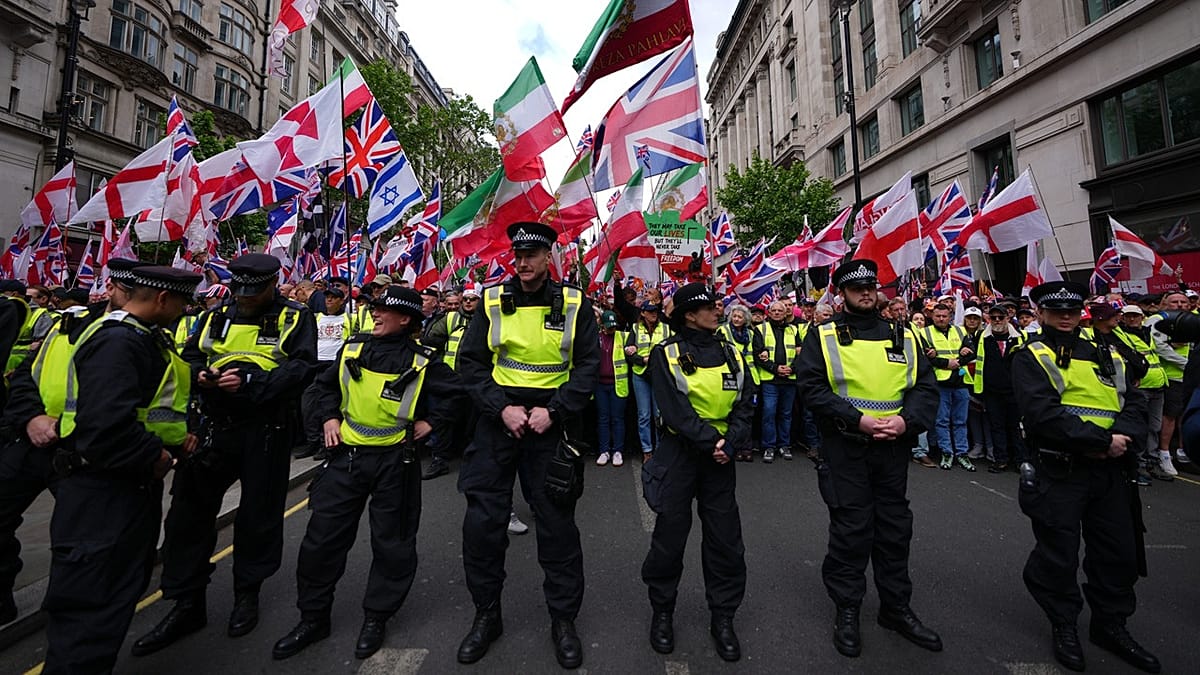
London, a city renowned for its historical landmarks and vibrant cultural tapestry, found itself at a critical juncture on a recent Saturday, grappling with deep societal divisions. The Metropolitan Police orchestrated an immense security operation, deploying an unprecedented 4,000 officers alongside mounted units, K9 teams, drones, and helicopters. Their mission: to manage two ideologically opposed mass demonstrations – a far-right march led by Tommy Robinson and a pro-Palestinian rally marking Nakba Day – all while simultaneously ensuring public safety for the tens of thousands of football fans attending the FA Cup Final. This extraordinary convergence of events underscored the escalating challenges faced by authorities in maintaining order amidst a polarized public sphere.
A City Under Strain: The Logistics of Division
The sheer scale of the police operation was a testament to the perceived risk of public disorder. With 4,000 officers on duty, it represented one of the largest single-day deployments in recent memory, rivaling operations for major state events or terrorist threats. The strategic deployment aimed to create physical barriers between the opposing factions, primarily around the Whitehall area, a traditional focal point for protests. The far-right group, under the banner of Tommy Robinson's 'Unite the Kingdom' march, drew thousands, many traveling from outside London. Their stated purpose was to protest against 'Islamist extremism' and to support veterans. Simultaneously, a significant pro-Palestinian demonstration, commemorating Nakba Day – the 'catastrophe' of Palestinian displacement in 1948 – also mobilized thousands, advocating for Palestinian rights and an end to the conflict in Gaza. The presence of both groups in close proximity, each with passionate and often confrontational rhetoric, presented a volatile cocktail for law enforcement. Adding to this complexity was the presence of tens of thousands of football supporters heading to Wembley Stadium for the FA Cup Final, requiring additional resources to manage crowd flow and prevent any spillover of unrest.
The Roots of Discontent: Understanding the Factions
The far-right demonstration, spearheaded by figures like Tommy Robinson (real name Stephen Yaxley-Lennon), taps into a vein of anti-immigrant and anti-Islam sentiment that has simmered in parts of the UK for years. Robinson, a controversial figure with a history of convictions, leverages social media to mobilize supporters who feel disenfranchised and believe their cultural identity is under threat. Their narrative often frames issues through a lens of 'us vs. them,' portraying mainstream institutions as failing to address what they perceive as pressing societal dangers. The pro-Palestinian movement, conversely, represents a long-standing global solidarity effort, intensified by the recent conflict in Gaza. Nakba Day serves as a powerful annual reminder of historical injustices and ongoing dispossession, resonating deeply with British Palestinian communities and a broader coalition of human rights activists. While both groups express grievances, their fundamental ideologies and proposed solutions are diametrically opposed, making any direct interaction fraught with potential conflict. The rise of social media has further exacerbated these divisions, allowing echo chambers to flourish and radical narratives to gain traction, making consensus-building increasingly difficult.
Beyond the Headlines: Implications for London and Beyond
The events of that Saturday are more than just a logistical challenge for the police; they are a stark reflection of deepening societal fissures within the UK and across many Western democracies. The increasing frequency and intensity of rival demonstrations highlight a growing polarization that extends beyond specific political issues to fundamental questions of national identity, cultural values, and foreign policy. For London, a global city celebrated for its diversity, these events pose significant questions about social cohesion and the limits of free expression. The cost of such extensive policing operations is also substantial, diverting resources from other critical areas. Furthermore, the optics of such heavy-handed security measures, while necessary, can inadvertently contribute to a sense of unease and division within the populace. The challenge for policymakers and community leaders is not merely to manage these demonstrations but to address the underlying grievances and foster dialogue across ideological divides. Without such efforts, the risk of further fragmentation and potential unrest remains a persistent threat.
A Precarious Balance: Free Speech vs. Public Order
The right to protest is a cornerstone of democratic societies, enshrined in law and tradition. However, this right is not absolute and must be balanced against the need to maintain public order and prevent incitement to hatred or violence. The Metropolitan Police's strategy on this day was a delicate exercise in this balancing act. Their primary goal was to facilitate peaceful protest while preventing direct confrontation between hostile groups. This often involves creating designated routes, establishing buffer zones, and deploying significant resources to intervene quickly if tensions escalate. The use of advanced surveillance technologies, such as drones, allows for real-time monitoring and tactical adjustments. Yet, the very act of policing such events can be perceived differently by various groups, with some feeling their right to protest is being curtailed, while others demand stronger action against perceived extremism. This inherent tension makes the role of law enforcement incredibly challenging, requiring constant adaptation and a nuanced understanding of complex social dynamics. The long-term implications for public trust in institutions, particularly the police, are also significant, as their actions are scrutinized by all sides.
Looking Ahead: Navigating a Divided Future
The events in London serve as a potent reminder that the challenges of managing public dissent in an increasingly polarized world are here to stay. As global conflicts continue to reverberate locally and as different communities grapple with questions of identity and belonging, cities like London will likely face similar tests. The path forward requires a multi-faceted approach: robust and impartial policing to ensure safety, but also sustained efforts from political leaders, community organizations, and civil society to bridge divides. Investing in education, fostering inter-community dialogue, and addressing socio-economic inequalities that often fuel extremist narratives are crucial. Without a concerted effort to understand and mitigate the root causes of polarization, the sight of rival demonstrations requiring massive police deployments may become an increasingly common feature of urban landscapes. The future of social cohesion in diverse metropolises hinges on the ability to navigate these complex currents, protecting fundamental freedoms while safeguarding the peace.
Stay Informed
Get the world's most important stories delivered to your inbox.
No spam, unsubscribe anytime.
Comments
No comments yet. Be the first to share your thoughts!