Strait of Malacca's Resilience: Why Experts Dismiss a Hormuz-Style Crisis
Amidst global concerns over maritime security, experts are assuaging fears that the Strait of Malacca could face a crisis akin to that in the Strait of Hormuz. Strategic geopolitical alliances, robust international cooperation, and the unique characteristics of the Malacca waterway create a formidable deterrent against similar disruptions. This analysis delves into the factors safeguarding one of the world's most vital shipping lanes.
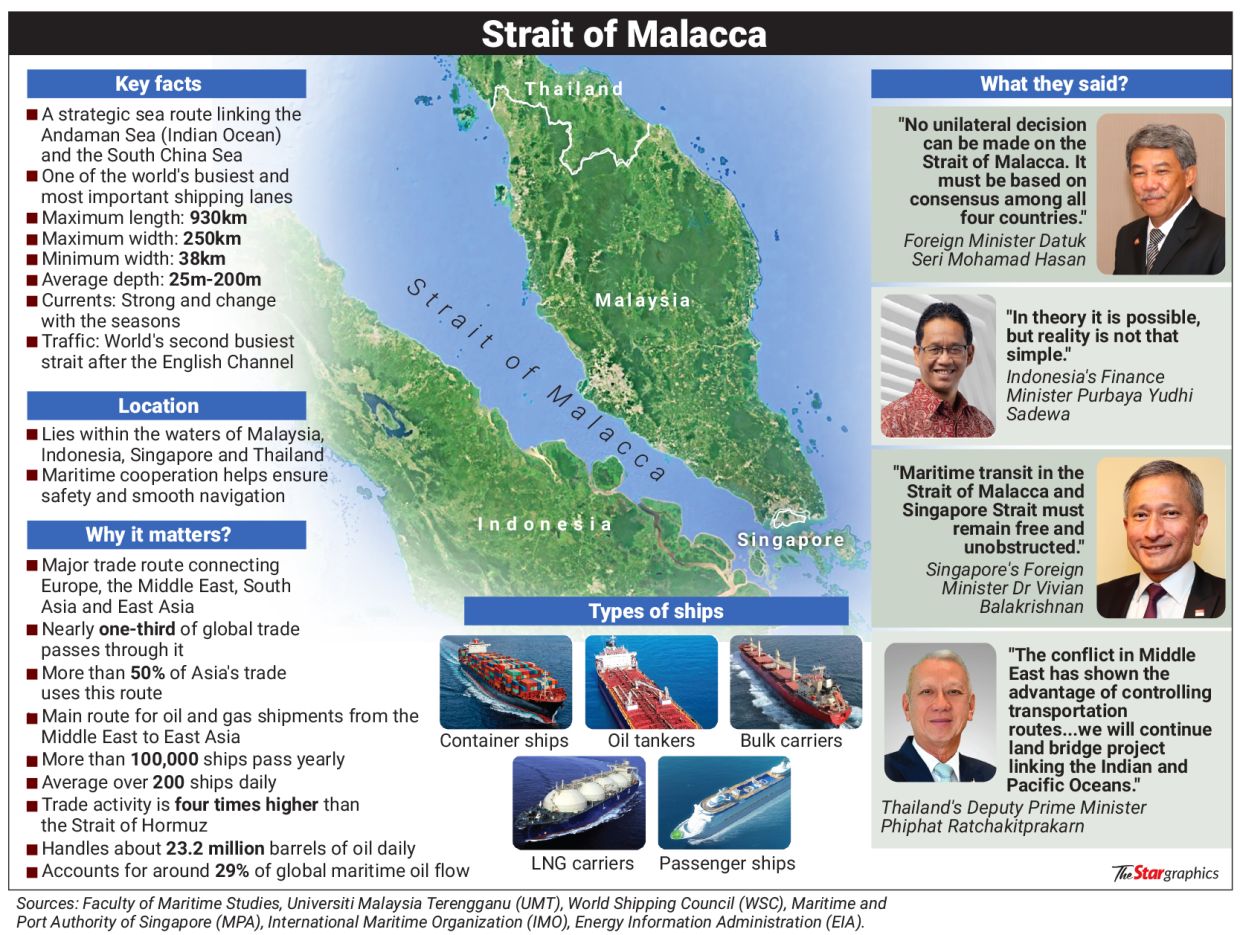
In an era marked by escalating geopolitical tensions and disruptions to global supply chains, the stability of critical maritime chokepoints has never been more paramount. The Strait of Hormuz, a narrow passage connecting the Persian Gulf to the open ocean, has frequently been a flashpoint, raising anxieties about the free flow of oil and international trade. Naturally, this has led many to question whether other vital arteries, such as the Strait of Malacca, could face similar perils. However, a consensus among experts suggests that the Strait of Malacca is uniquely positioned to avoid such a fate, thanks to a complex interplay of geopolitical dynamics, security cooperation, and economic realities.
“What is happening in the Strait of Hormuz is unlikely to befall the Strait of Malacca,” asserts Universiti Kebangsaan Malaysia (UKM) Prof Dr Salawati Mat Basir, a sentiment echoed by numerous security analysts and maritime strategists. This declaration offers a crucial reassurance to the global economy, given that the Strait of Malacca is not merely a shipping lane but a lifeline, handling an estimated one-quarter of the world’s seaborne trade and half of its oil shipments. Understanding the fundamental differences between these two critical waterways is key to appreciating Malacca’s relative security.
Geopolitical Landscape: A Tale of Two Straits
The starkest contrast between the Strait of Hormuz and the Strait of Malacca lies in their respective geopolitical environments. Hormuz is bordered by Iran on one side and the United Arab Emirates and Oman on the other, a region characterized by deep-seated rivalries, proxy conflicts, and a history of military confrontations. Iran’s strategic location and its often-strained relationship with Western powers and regional adversaries have frequently made the Strait a theatre for political leverage and military posturing. The potential for unilateral action or miscalculation remains a constant threat.
Conversely, the Strait of Malacca is flanked by Malaysia, Singapore, and Indonesia – three sovereign nations with a long history of cooperation, shared economic interests, and a collective commitment to regional stability. These countries are members of the Association of Southeast Asian Nations (ASEAN), an organization that prioritizes diplomacy, consensus-building, and multilateral security initiatives. This framework fosters a collaborative approach to maritime security, rather than a confrontational one. The influence of major global powers, while present, is largely channeled through cooperative mechanisms rather than competitive ones.
Robust Security Cooperation and Enforcement
The security architecture surrounding the Strait of Malacca is far more robust and integrated than that of Hormuz. The littoral states – Malaysia, Singapore, and Indonesia – have established sophisticated joint patrols and intelligence-sharing mechanisms to combat piracy, terrorism, and other maritime crimes. Initiatives like the Malacca Strait Patrols (MSP) and the ‘Eyes in the Sky’ (EIS) aerial surveillance program demonstrate a proactive and unified front against threats. These operations involve coordinated naval and air forces, significantly enhancing deterrence and response capabilities.
Furthermore, the international community has a vested interest in the Strait's stability and actively contributes to its security. Major maritime powers like the United States, China, Japan, and India all rely heavily on the Strait for their trade and energy supplies. While their presence in the broader Indo-Pacific region can sometimes be competitive, their shared interest in keeping Malacca open and safe often translates into support for regional security efforts. This multilateral engagement provides an additional layer of security, making any hostile disruption a far more complex and internationally condemned act.
Economic Interdependence and Global Stakes
The economic implications of disrupting the Strait of Malacca are staggering, far surpassing those of Hormuz in terms of sheer volume and diversity of goods. While Hormuz is primarily an oil conduit, Malacca carries everything from crude oil and LNG to manufactured goods, electronics, and agricultural products. It is the shortest sea route between the Middle East, Europe, and Africa on one side, and Asia's economic powerhouses like China, Japan, and South Korea on the other. A closure or significant disruption would not only send oil prices soaring but would also cripple global manufacturing, cause widespread food shortages, and trigger an unprecedented economic crisis.
This immense economic interdependence acts as a powerful deterrent. No single actor, state or non-state, would find it strategically advantageous to jeopardize a waterway that is so critical to their own economic well-being and that of their trading partners. The potential for severe global backlash and immediate, overwhelming international intervention would be immense, making any such action economically suicidal and politically untenable. The sheer volume of traffic – approximately 120,000 vessels annually – also presents a logistical challenge for any disruptive force, as it would require an immense and sustained effort to blockade or control effectively.
Historical Context and Lessons Learned
The Strait of Malacca has not been without its security challenges. In the early 2000s, it was notorious for piracy, which posed a significant threat to shipping. However, the concerted efforts of the littoral states, supported by international cooperation, dramatically reduced piracy incidents to negligible levels. This success story stands as a testament to the effectiveness of collaborative security frameworks and the political will to protect this vital artery. The lessons learned from combating piracy have strengthened regional cooperation and built trust among the navies and maritime agencies of Malaysia, Singapore, and Indonesia.
This historical experience contrasts sharply with the persistent, politically charged security issues in Hormuz, where the underlying geopolitical tensions have proven far more intractable. The Malacca states have demonstrated a capacity for adaptive governance and effective crisis management, qualities that are essential for maintaining stability in such a critical global chokepoint. The focus has always been on ensuring safe passage for all, rather than using the Strait as a tool for political leverage.
The Path Forward: Sustained Vigilance and Cooperation
While experts are confident that a Hormuz-style crisis is unlikely, complacency is not an option. The dynamic nature of global threats, including potential acts of terrorism, environmental disasters, or even sophisticated cyberattacks targeting maritime infrastructure, necessitates sustained vigilance. The littoral states, with continued international support, must continue to invest in advanced surveillance technologies, enhance intelligence sharing, and conduct regular joint exercises to maintain their readiness.
Furthermore, diplomatic efforts to de-escalate regional tensions in Southeast Asia and foster greater trust among all stakeholders remain crucial. The Strait of Malacca’s security is a shared responsibility, and its continued stability is a testament to effective multilateralism. As global trade continues to expand, the principles of cooperation and mutual interest that safeguard Malacca will serve as a vital model for other critical maritime passages, ensuring the arteries of global commerce remain open and secure for the benefit of all nations. The world can breathe a collective sigh of relief, knowing that this crucial waterway is in capable and cooperative hands, unlikely to mirror the volatile challenges faced elsewhere.
Stay Informed
Get the world's most important stories delivered to your inbox.
No spam, unsubscribe anytime.
Comments
No comments yet. Be the first to share your thoughts!