Beyond the Blink: Unpacking the $500 Camera That Sees 685 Billion Frames Per Second
A groundbreaking imaging system, developed by a dedicated research team, promises to revolutionize scientific observation by capturing events at an astonishing 685 billion frames per second, all for under $500. This article delves into the ingenious 'catch' behind this ultra-fast technology, exploring its mechanics, potential applications, and the profound implications for fields ranging from medical diagnostics to fundamental physics. Discover how this affordable innovation could unlock new frontiers in understanding the universe at its most fleeting moments.
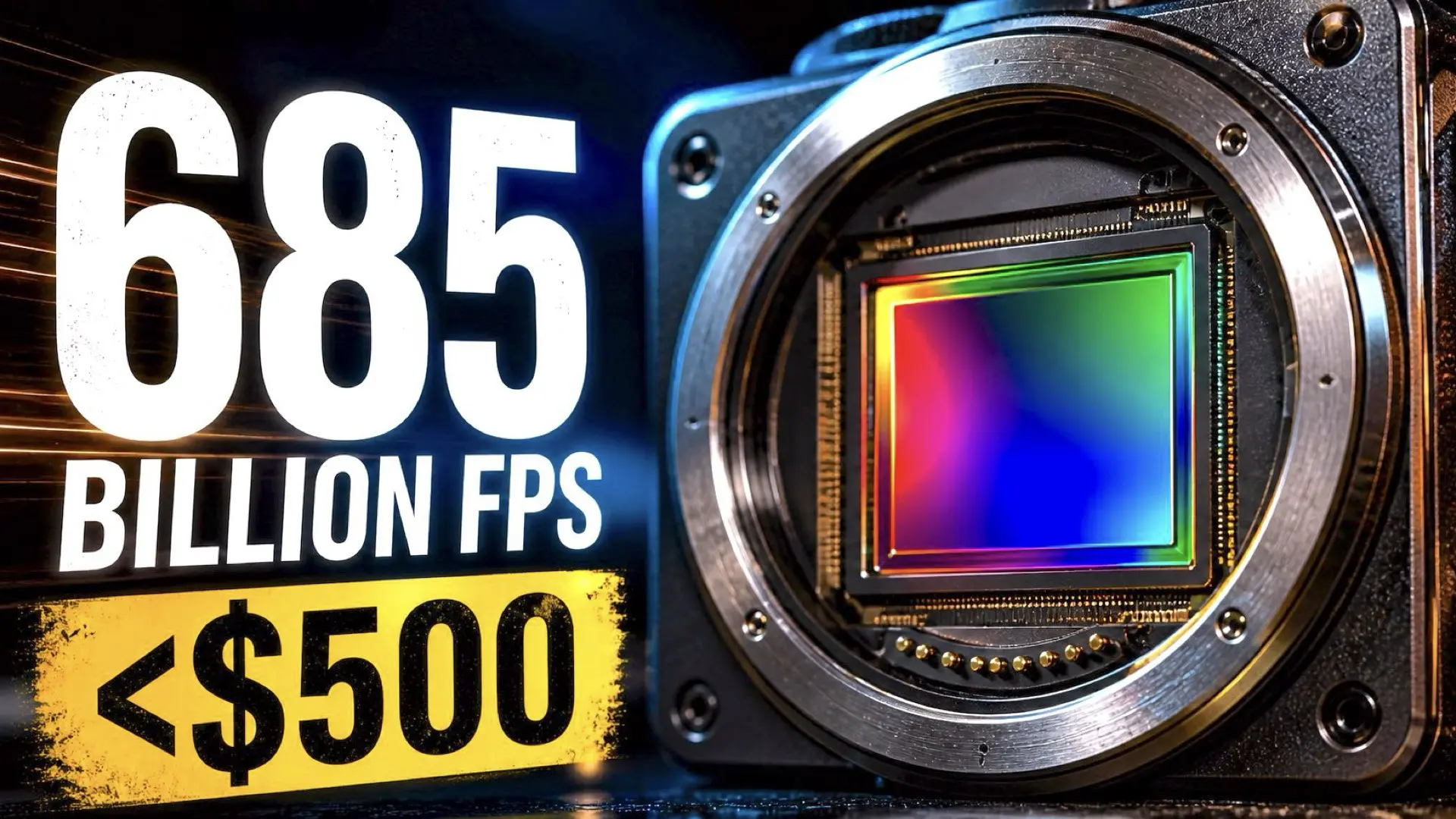
In an era defined by rapid technological advancement, a recent breakthrough has emerged from the scientific community that sounds almost too good to be true. A research team has reportedly developed an imaging system capable of capturing phenomena at an astounding effective speed of 685 billion frames per second (FPS), all while costing less than $500. This isn't the stuff of science fiction; it's a tangible innovation poised to redefine our understanding of the fastest events in the universe. PulseWorld delves into the mechanics, implications, and the subtle 'catch' that makes this seemingly impossible feat a reality.
The Illusion of Speed: How It Works
The immediate reaction to a camera boasting 685 billion FPS for under $500 is often skepticism, and rightly so. Traditional high-speed cameras, capable of millions of frames per second, cost hundreds of thousands, if not millions, of dollars. The secret behind this new system isn't a single, impossibly fast sensor, but rather an ingenious approach to data acquisition and reconstruction. The 'catch' lies in its methodology: it doesn't capture 685 billion individual frames in a sequential burst like a conventional camera. Instead, it employs a technique that effectively achieves this speed through a combination of stroboscopic imaging and computational reconstruction.
Imagine trying to photograph a bullet mid-flight. A regular camera would capture a blur. A high-speed camera takes many distinct pictures as the bullet moves. This new system, however, operates more like a highly sophisticated, rapid-fire strobe light combined with a single, slower sensor. It illuminates the event with incredibly short, precisely timed pulses of light, each pulse capturing a 'slice' of the event's progression onto a sensor. By repeating this process over many cycles, slightly shifting the timing of the light pulses relative to the event, and then computationally stitching these 'slices' together, the system reconstructs a complete, ultra-fast video. This method bypasses the need for an impossibly fast sensor by distributing the temporal information across multiple captures, effectively creating a temporal resolution far beyond the sensor's native speed. This approach significantly reduces the hardware complexity and, consequently, the cost.
A Historical Perspective: The Quest for Speed
The pursuit of capturing fleeting moments is as old as photography itself. From Eadweard Muybridge's pioneering work in the late 19th century, which used a series of still cameras to analyze horse locomotion, to Harold Edgerton's iconic 'milk drop coronet' photographs of the mid-20th century, scientists and artists have continually pushed the boundaries of temporal resolution. Early high-speed cameras relied on mechanical shutters and film, gradually evolving into electronic sensors capable of thousands, then millions, of frames per second. These advancements were crucial for understanding phenomena like ballistics, fluid dynamics, and chemical reactions.
However, the physical limitations of sensor readout speeds and data transfer rates have always presented a formidable barrier. Capturing events like light propagation, molecular interactions, or neural impulses—which occur on picosecond (trillionths of a second) or femtosecond (quadrillionths of a second) timescales—has traditionally required highly specialized, expensive, and often cumbersome equipment, such as streak cameras or pump-probe spectroscopy setups. This new $500 system represents a significant democratization of ultra-fast imaging, potentially making previously inaccessible research tools available to a much broader scientific community.
Unlocking New Frontiers: Applications and Implications
The potential applications of a sub-$500 camera capable of 685 billion FPS are vast and transformative. This technology could fundamentally alter research across numerous scientific and industrial disciplines:
* Physics and Chemistry: Observing light propagation in real-time, understanding the dynamics of chemical bonds breaking and forming, or analyzing plasma physics and fusion reactions with unprecedented detail. This could lead to breakthroughs in energy generation and materials science. * Biology and Medicine: Visualizing neural impulses traveling through brain tissue, tracking drug delivery at a cellular level, or studying the ultra-fast processes involved in photosynthesis. Early detection of diseases could be revolutionized by observing cellular anomalies at their earliest stages. * Engineering and Materials Science: Analyzing crack propagation in materials, optimizing laser-material interactions for manufacturing, or studying the behavior of shockwaves. This could lead to stronger materials and more efficient industrial processes. * Security and Defense: Improving ballistics analysis, developing more effective countermeasures against high-speed threats, or understanding the dynamics of explosions with greater precision.
The affordability of this system is a game-changer. Previously, only well-funded institutions could afford such capabilities. Now, university labs, smaller research groups, and even advanced hobbyists could gain access to tools that reveal the universe's most fleeting secrets. This democratization could accelerate discovery by fostering innovation in unexpected places.
The Road Ahead: Challenges and Future Outlook
While the promise of this technology is immense, it's important to acknowledge that it comes with its own set of challenges and considerations. The 'catch' of computational reconstruction means that the system isn't capturing a continuous stream of frames in the traditional sense. This might introduce certain limitations regarding the types of events that can be effectively observed or the complexity of the reconstruction process. Data processing for such immense temporal resolution will also require significant computational power, though modern GPUs are increasingly capable of handling such tasks.
Furthermore, the system's reliance on precisely timed light pulses implies that it might be best suited for events that can be triggered or are repeatable. Observing spontaneous, non-repeatable events might still pose a challenge. However, these are engineering hurdles that can likely be overcome with further research and development.
Looking forward, this $500 ultra-fast camera represents more than just a new piece of equipment; it's a paradigm shift in how we approach high-speed imaging. It underscores the power of computational photography and the ability to achieve extraordinary results with relatively modest hardware through clever algorithms and innovative design. As this technology matures, we can anticipate a future where the invisible becomes visible, where the fastest processes of nature are laid bare for study, and where scientific discovery accelerates at an unprecedented pace. The universe, in all its fleeting glory, is about to reveal more of its secrets, one billionth of a second at a time.
Stay Informed
Get the world's most important stories delivered to your inbox.
No spam, unsubscribe anytime.
Comments
No comments yet. Be the first to share your thoughts!