Icon Under Siege: Israeli Army Probes Soldier's Alleged Vandalism of Jesus Statue in Lebanon, Igniting Regional Tensions
An image circulating on social media, purportedly showing an Israeli soldier striking a statue of Jesus Christ in southern Lebanon with a hammer, has prompted an official investigation by the Israeli army. This incident, if authenticated, risks significantly escalating religious and political tensions in an already volatile region, drawing widespread condemnation and raising questions about military conduct. The probe highlights the complex interplay of faith, conflict, and digital information warfare in the Middle East.
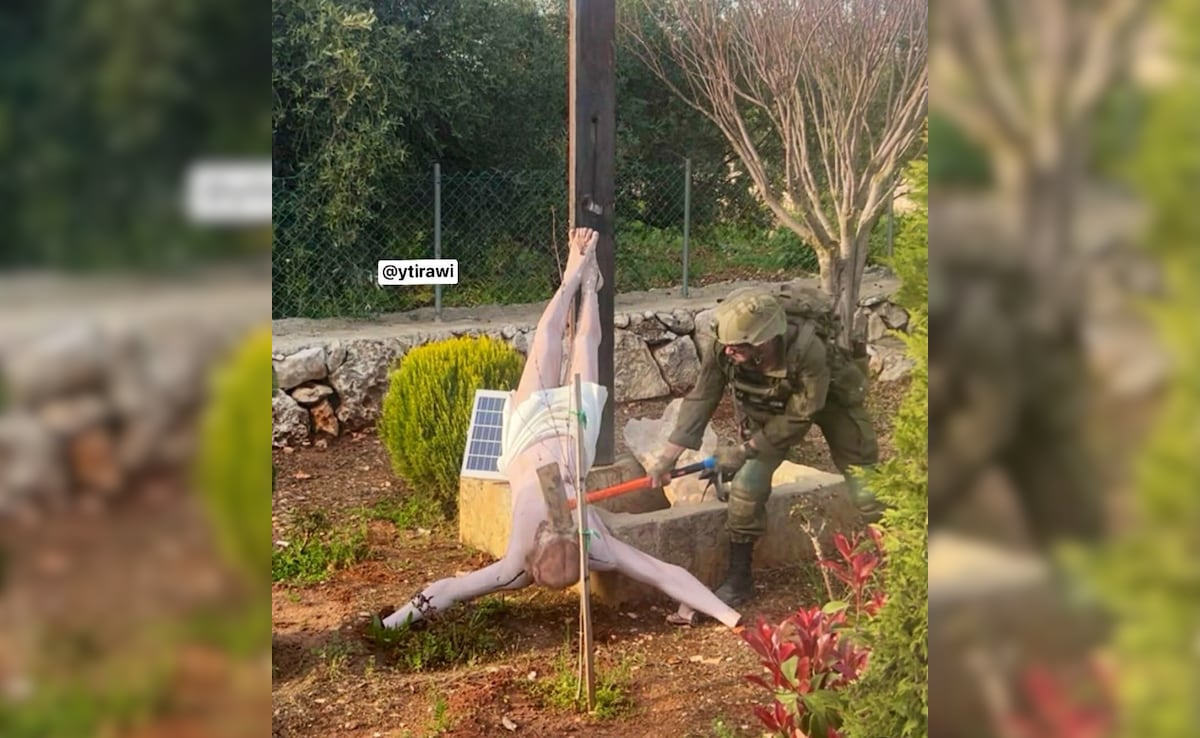
The crucible of the Middle East, perpetually simmering with geopolitical and religious tensions, has once again been stirred by a provocative image. An photograph, now widely circulated across social media platforms, appears to depict an Israeli soldier in southern Lebanon striking a statue of Jesus Christ with a hammer. This deeply disturbing visual has not only sparked immediate outrage but has also compelled the Israeli army to launch an urgent investigation into its authenticity and the circumstances surrounding it. The incident, irrespective of its final verification, casts a long shadow over the already fragile relations in the region, threatening to ignite a new front of religious animosity amidst ongoing conflicts.
The Incident: A Spark in the Powder Keg
The image surfaced on Sunday, quickly gaining traction across various social media channels, particularly X (formerly Twitter), where Israeli army spokesman Nadav Shoshani acknowledged the military's awareness of the photograph. His statement confirmed that the Israel Defense Forces (IDF) were actively looking into the matter, indicating the seriousness with which the potential act of desecration is being treated. The location, southern Lebanon, is itself a highly sensitive area, a historical flashpoint between Israel and Hezbollah, a powerful Shiite militant group and political party. Any act perceived as an affront to religious symbols in this region carries immense weight and the potential for severe repercussions.
Statues and religious iconography, particularly those depicting figures revered across multiple faiths, hold profound significance. For Christians worldwide, Jesus Christ is the central figure of their faith, and any act of vandalism against his image is considered a grave sacrilege. In a region where religious identities are deeply intertwined with national and political narratives, such an act could easily be framed as a deliberate provocation, regardless of the individual soldier's intent. The digital age ensures that such images spread like wildfire, often outstripping official responses and shaping public perception before facts are fully established. This rapid dissemination means the damage to reputation and the fueling of animosity can occur almost instantaneously.
Historical Precedents and Regional Sensitivities
The Middle East is a mosaic of faiths – Islam, Christianity, Judaism – each with ancient roots and often overlapping holy sites. History is replete with instances where the desecration of religious symbols has served as a catalyst for conflict, or at the very least, a significant exacerbation of existing tensions. From the destruction of ancient Buddhist statues by the Taliban to the repeated clashes over holy sites in Jerusalem, the vulnerability of religious heritage in times of conflict is a recurring tragedy. In this context, the alleged act by an Israeli soldier is not merely an act of individual misconduct; it is viewed through the lens of a broader, often militarized, ethno-religious conflict.
Lebanon, in particular, has a significant Christian population, and the protection of their religious sites is a matter of national pride and inter-communal harmony. The Maronite Christian community, one of the largest Christian groups in the Middle East, holds deep reverence for such symbols. An attack on a statue of Jesus in southern Lebanon could be interpreted not just as an attack on Christianity, but as an assault on Lebanese sovereignty and its diverse religious fabric. This adds another layer of complexity to the incident, moving it beyond a simple act of vandalism to a potential international incident with far-reaching diplomatic and social consequences.
The IDF's Dilemma: Investigation and Accountability
The Israeli army's swift announcement of an investigation underscores the institution's awareness of the potential ramifications. In modern warfare, particularly in areas with high civilian populations and complex religious demographics, military forces are under intense scrutiny regarding their conduct. Rules of Engagement (ROE) typically include provisions for respecting religious sites and cultural heritage. Any deviation from these rules, especially one that appears to be a deliberate act of desecration, can lead to charges of war crimes or at least severe breaches of military discipline.
The investigation will likely focus on several key aspects: * Authenticity of the image: Is the image real or digitally manipulated? This is the primary question. Deepfakes and doctored images are increasingly sophisticated, making verification a complex task. * Identification of the soldier: If authentic, who is the soldier, and what was their motive? Was it an act of individual malice, a misguided prank, or something more systemic? * Circumstances: What was the operational context? Was the soldier acting alone or under orders? What was the chain of command's awareness? * Impact on military discipline: How will the IDF address such behavior if proven true? What disciplinary actions will be taken to uphold military values and prevent future occurrences?
The IDF has historically faced criticism and conducted investigations into alleged misconduct by its soldiers, ranging from civilian casualties to property damage. The outcome of this particular probe will be crucial not only for internal accountability but also for managing Israel's international image and its relations with Christian communities globally, and particularly in the Middle East.
Implications for Regional Stability and Information Warfare
This incident, whether confirmed or not, plays directly into the ongoing information warfare that accompanies kinetic conflicts in the Middle East. Adversaries of Israel, such as Hezbollah and other Iranian-backed groups, are quick to seize upon such images to fuel anti-Israeli sentiment, portray Israel as an aggressor against religious minorities, and rally support for their own causes. The image becomes a powerful propaganda tool, capable of mobilizing public opinion and justifying retaliatory actions.
Conversely, if the image is proven to be a fabrication, it highlights the dangers of misinformation and disinformation in conflict zones. The ease with which false narratives can be constructed and disseminated poses a significant challenge to truth and reconciliation efforts. It forces news organizations and the public alike to exercise extreme caution and critical thinking when consuming information from unverified sources, especially during times of heightened tension.
For the Christian communities in the Middle East, who often find themselves caught between warring factions, such incidents are deeply unsettling. They underscore their precarious position and the constant threat to their heritage and way of life. International bodies and religious leaders will undoubtedly watch the IDF's investigation closely, urging for transparency and justice.
A Call for Restraint and Respect
The alleged act of vandalism in southern Lebanon serves as a stark reminder of the delicate balance in the Middle East, where every action, no matter how isolated, can have far-reaching consequences. It underscores the imperative for all parties in any conflict to uphold the highest standards of conduct, particularly concerning religious and cultural heritage. Respect for sacred sites and symbols is not merely a matter of military protocol; it is a fundamental pillar of human dignity and a prerequisite for any hope of lasting peace.
The Israeli army's investigation is a critical step towards establishing the truth and, if necessary, ensuring accountability. However, the emotional and political fallout from the image has already begun, further complicating an already intractable conflict. As the world watches, the incident serves as a poignant illustration of how easily religious sensitivities can be exploited, and how urgently restraint, respect, and a commitment to truth are needed in a region yearning for stability.
Stay Informed
Get the world's most important stories delivered to your inbox.
No spam, unsubscribe anytime.
Comments
No comments yet. Be the first to share your thoughts!