IDF Soldier's Jesus Statue Incident in Lebanon Ignites International Outrage, Prompts Investigation
An image circulating online, purportedly showing an IDF soldier striking a statue of Jesus Christ in southern Lebanon, has sparked widespread international condemnation and outrage, particularly among Christian communities. Israel's military has launched an investigation into the incident, acknowledging initial findings suggest the soldier's involvement. This event exacerbates already heightened tensions in the region, raising serious questions about military conduct and religious sensitivities amidst ongoing conflict.
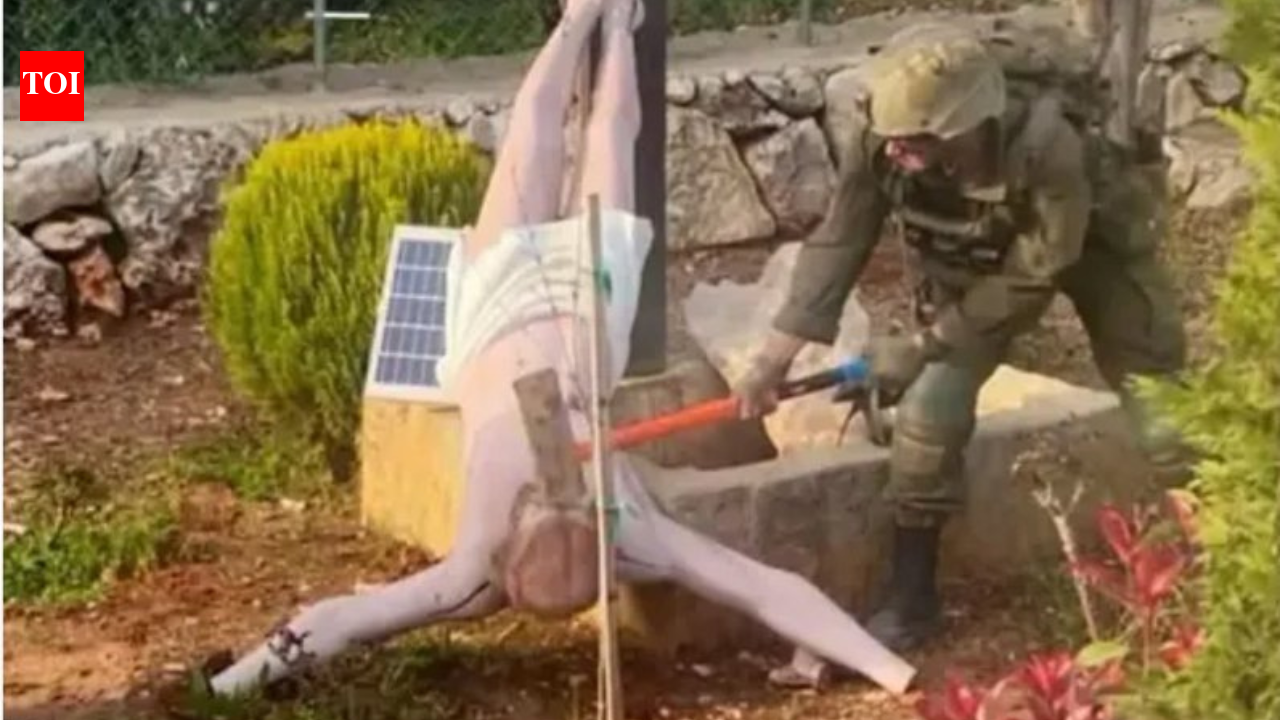
In a region perpetually on edge, a single photograph has ignited a firestorm of controversy, threatening to further destabilize an already volatile geopolitical landscape. The image, widely circulated across social media platforms, appears to depict an Israel Defense Forces (IDF) soldier striking a statue of Jesus Christ in southern Lebanon. This act, perceived as a profound desecration by many, has triggered immediate and widespread international outrage, prompting Israel’s military to launch a swift investigation into the matter.
For Christian communities globally, and particularly those in the Middle East, the image represents an egregious affront to their faith and heritage. The incident comes at a time of escalating tensions along the Israel-Lebanon border, where exchanges of fire have become a grim daily reality since the October 7 attacks and the subsequent conflict in Gaza. While the IDF has confirmed an initial examination suggests the soldier's involvement, the full context and motivations behind the act remain under scrutiny, fueling a furious debate about military conduct, religious respect, and the broader implications for regional stability.
The Incident and Immediate Aftermath
The photograph first surfaced online, quickly going viral and drawing condemnation from various quarters. It shows a uniformed individual, identifiable as an IDF soldier, in close proximity to a religious statue, seemingly in the act of striking it. The location was identified as southern Lebanon, an area that has seen significant military activity and incursions by Israeli forces in recent months. The immediate reaction was one of shock and anger, particularly from Christian leaders and organizations who viewed the act as a deliberate attack on religious symbols.
The Israeli military was quick to respond to the burgeoning crisis. An official statement from the IDF confirmed that an investigation had been launched. "An initial examination found that the soldier seen in the photograph is an IDF soldier," the statement read, adding that "the circumstances of the incident are being investigated." This swift acknowledgment, while necessary, did little to quell the outrage, instead shifting the focus to the potential disciplinary actions and the broader message such an act sends. The incident has been widely interpreted as a violation of military ethics and a profound disrespect for religious sites and symbols, regardless of the soldier's intent.
Historical Context of Religious Sites in Conflict Zones
The Middle East is the cradle of three major Abrahamic religions: Judaism, Christianity, and Islam. Consequently, the region is replete with sites of immense religious significance, many of which have unfortunately become collateral damage or deliberate targets in various conflicts throughout history. The protection of religious and cultural heritage during armed conflict is enshrined in international humanitarian law, notably the 1954 Hague Convention for the Protection of Cultural Property in the Event of Armed Conflict.
Previous conflicts in the region have seen numerous instances where religious sites have been damaged or destroyed, often leading to international outcry and accusations of war crimes. From the destruction of ancient Palmyra by ISIS to the damage sustained by mosques and churches in various war zones, the targeting or desecration of religious symbols is consistently viewed as a grave offense. For Christians in Lebanon, a country with a significant and historically influential Christian population, the statue of Jesus holds deep cultural and spiritual resonance. Any perceived attack on such a symbol touches a raw nerve, evoking memories of past sectarian strife and fears for the future of their communities.
Implications for Regional Tensions and International Relations
This incident arrives at a particularly sensitive moment. The ongoing conflict between Israel and Hamas in Gaza has already spilled over into Lebanon, with daily exchanges of fire between the IDF and Hezbollah, a powerful Shiite militant group and political party. The Lebanese government has repeatedly expressed concerns about Israeli violations of its sovereignty, and this incident only serves to fuel anti-Israel sentiment within Lebanon and across the wider Arab and Muslim world.
Furthermore, the image has the potential to complicate Israel's international standing, particularly with Christian-majority nations and communities that have historically been supportive. Evangelical Christians, a key demographic for Israel in the United States, might find such an act deeply disturbing. It provides ammunition for critics who accuse Israeli forces of indiscriminate actions and a lack of respect for non-Jewish religious sites, undermining diplomatic efforts and public relations campaigns aimed at garnering international sympathy and support.
Expert analysts suggest that incidents like these, even if isolated, can have disproportionate impacts on public perception and diplomatic relations. "In the current climate, every action by a soldier is scrutinized under a magnifying glass," says Dr. Elias Haddad, a Middle East political analyst. "An act like this, especially involving a religious icon, can quickly be weaponized by adversaries and erode trust among allies. It plays directly into narratives of disrespect and occupation, making de-escalation even harder."
IDF's Stance and Future Actions
Following the initial confirmation, the IDF has reiterated its commitment to upholding military values and international law. The military's spokesperson office stated that "the IDF respects all religions and religious sites and condemns any behavior that violates these values." Such statements are crucial for damage control, but the true test will be the transparency and outcome of the investigation.
Potential consequences for the soldier involved could range from disciplinary action within the military to criminal charges, depending on the severity and intent determined by the investigation. The IDF has a reputation for conducting internal investigations, though their outcomes are not always fully transparent to the public. For this particular incident, given its international resonance, there will be immense pressure for a thorough and publicly accountable process.
Beyond disciplinary measures, the incident highlights the need for continuous education and cultural sensitivity training for soldiers operating in diverse and religiously significant regions. Troops deployed in areas with complex religious demographics must be acutely aware of the local customs, beliefs, and the sanctity of religious sites to prevent such damaging incidents from recurring. This is not merely about avoiding public relations fiascos but about upholding the ethical standards expected of a modern military force operating in a globalized world.
Conclusion: A Test of Values and Diplomacy
The image of an IDF soldier striking a statue of Jesus Christ is more than just an isolated act of misconduct; it is a potent symbol that has resonated deeply across religious and political divides. It serves as a stark reminder of the fragile nature of peace and coexistence in the Middle East, where religious sensitivities are perpetually intertwined with political grievances and military actions. The incident challenges the IDF to demonstrate its commitment to its stated values and to international norms regarding religious respect. For the international community, it underscores the urgent need for de-escalation and dialogue, lest such incidents further inflame a region already teetering on the brink. The path forward demands not only accountability for the individual involved but also a renewed commitment from all parties to uphold the sanctity of religious sites and foster mutual respect, even amidst the throes of conflict. The world watches, waiting to see if this incident will lead to genuine introspection and change, or merely become another scar on the long, troubled history of the Middle East.
Stay Informed
Get the world's most important stories delivered to your inbox.
No spam, unsubscribe anytime.
Comments
No comments yet. Be the first to share your thoughts!