ODM Rift Deepens: Odinga Family vs. Mbadi in High-Stakes Political Showdown
A significant political schism is tearing through Kenya's Orange Democratic Movement (ODM), pitting the influential Odinga family against Treasury Cabinet Secretary John Mbadi. The public spat, ignited by Winnie Odinga's intervention, exposes deep-seated power struggles and ideological differences within one of Kenya's most dominant political parties. As the internal conflict escalates, observers question the party's future cohesion and its role in the nation's political landscape, especially in the wake of recent electoral outcomes.
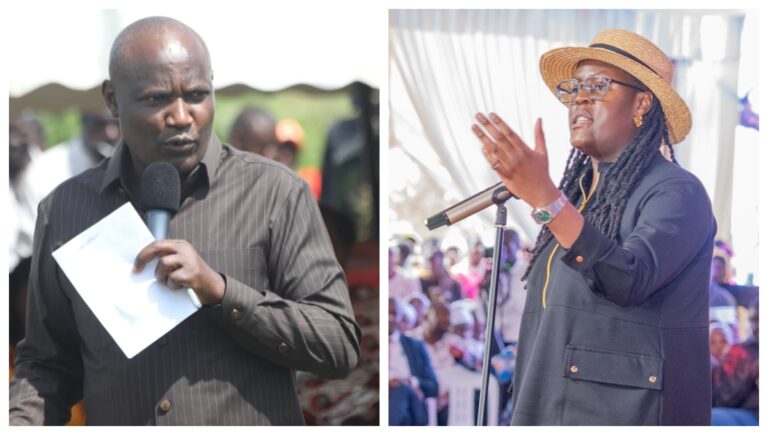
The political landscape of Kenya's Orange Democratic Movement (ODM) is currently experiencing a seismic internal tremor, as a simmering dispute between the powerful Odinga family and Treasury Cabinet Secretary John Mbadi has erupted into a full-blown public confrontation. This escalating feud, initially characterized by veiled criticisms and political maneuvering, has now drawn in East African Legislative Assembly (EALA) member Winnie Odinga, daughter of ODM patriarch Raila Odinga, signaling a critical juncture for the party's future cohesion and leadership.
The genesis of this current conflagration lies in a complex interplay of succession politics, perceived betrayals, and the ever-present struggle for influence within the ODM, a party that has long been a dominant force in Kenyan politics. For years, the ODM has been synonymous with the Odinga name, its political fortunes inextricably linked to Raila Odinga's charismatic leadership and his enduring quest for the presidency. However, the recent general elections, which saw Odinga narrowly lose the presidential race, have seemingly opened Pandora's Box, exposing fault lines that were perhaps always present but previously contained under the umbrella of a unified electoral objective.
The Roots of Discontent: Mbadi's Stance and Odinga's Legacy
John Mbadi, a long-serving and prominent figure within the ODM, has been increasingly vocal about the party's direction and internal dynamics. His criticisms, often subtle but pointed, have centered on what he perceives as a lack of internal democracy, a disconnect between the party's leadership and its grassroots, and perhaps most significantly, a need for generational change and a re-evaluation of the party's strategic approach. Mbadi's recent appointment as Treasury Cabinet Secretary, a position of significant national influence, has arguably emboldened him, giving his voice greater weight and a platform beyond mere party politics.
His public comments, particularly those questioning the party's post-election strategy and the influence of certain individuals, have been interpreted by many as a direct challenge to the Odinga family's traditional hegemony. Mbadi, a former ODM chairman, represents a faction that believes the party needs to evolve beyond its reliance on a single personality, advocating for a more institutionalized and democratic structure. This perspective, while not entirely new, gains significant traction in the aftermath of electoral defeat, where introspection and accountability become paramount.
Winnie Odinga's Intervention: A Family's Defense
The entry of Winnie Odinga into the public fray has dramatically raised the stakes. Her direct and often fiery rebuttals to Mbadi's criticisms are not merely the words of an EALA member; they carry the implicit weight of the Odinga family. Winnie's defense of her father's legacy and the family's role in the party underscores the deeply personal nature of this political struggle. Her public statements, which have included accusations of disloyalty and opportunism against those criticizing the party's leadership, reflect a perception within the Odinga camp that Mbadi's actions constitute a betrayal of the party's core principles and its long-standing leadership.
This family-centric defense highlights a fundamental tension within the ODM: whether it is a democratic institution guided by collective decision-making or a political vehicle primarily serving the ambitions and legacy of its founding family. Winnie's vocal stance signals a clear message: the Odinga family is not prepared to cede ground easily, and any challenge to their authority will be met with firm resistance. This dynamic makes reconciliation particularly challenging, as it moves beyond mere policy disagreements into the realm of personal loyalty and historical allegiance.
Implications for ODM's Future and Kenyan Politics
The deepening rift within the ODM carries significant implications, not just for the party itself but for the broader Kenyan political landscape. Historically, the ODM has been a formidable opposition force, often setting the agenda for national discourse and providing a critical check on government power. A fractured ODM risks diminishing its effectiveness as an opposition voice, potentially creating a power vacuum that other political entities might seek to fill. The party's ability to mobilize its significant support base, particularly in its traditional strongholds, could be severely hampered if internal divisions persist and deepen.
Furthermore, this internal conflict could influence future electoral alignments and coalition formations. If key figures like Mbadi feel marginalized or disrespected, they might explore alternative political avenues, potentially leading to defections or the formation of new political groupings. This fragmentation could weaken the opposition bloc, inadvertently strengthening the ruling coalition by reducing the potency of its adversaries. The political chess game in Kenya is often characterized by fluid alliances and strategic defections, and the ODM's internal turmoil could trigger a cascade of such realignments.
Key considerations for the ODM's future include:
* Leadership Succession: The ongoing debate implicitly touches upon who will eventually take the reins from Raila Odinga. Mbadi's challenge could be seen as an early play for influence in a post-Raila era. * Party Ideology: Is the ODM still committed to its original social democratic ideals, or has it become primarily an electoral machine? The internal debate may force a re-evaluation of its core tenets. * Grassroots Engagement: How will the party reconcile the aspirations of its rank-and-file members with the decisions made by its top leadership, especially amidst public disagreements? * Electoral Performance: A disunited party is unlikely to perform well in future elections, jeopardizing its status as a major political player.
Expert Analysis and Historical Parallels
Political analysts are closely watching the ODM's internal dynamics, drawing parallels with other major African political parties that have faced similar challenges. Dr. Makau Mutua, a prominent Kenyan political commentator, has often highlighted the 'big man' syndrome in African politics, where parties revolve around charismatic leaders rather than strong institutions. The ODM's current predicament seems to fit this pattern, where the transition from one dominant figure to a more collective leadership model proves fraught with difficulty.
Historically, parties that fail to manage internal dissent and succession effectively often face decline. We've seen instances across the continent where internal rifts have led to significant electoral losses or even the complete dissolution of once-powerful political movements. The ODM's ability to navigate this crisis will be a testament to its institutional resilience and its capacity for self-renewal. The party's constitution and internal democratic mechanisms will be put to the ultimate test.
The Path Forward: Reconciliation or Rupture?
The immediate future of the ODM hinges on whether its warring factions can find a path towards reconciliation or if the current public spat will lead to an irreparable rupture. A genuine reconciliation would require significant concessions from both sides: the Odinga family acknowledging the need for broader consultation and internal democracy, and figures like Mbadi expressing their grievances through established party channels rather than public platforms. Mediation by respected party elders or neutral figures might be necessary to bridge the growing chasm.
However, the intensity of the public exchanges suggests that positions have hardened, making a swift resolution unlikely. The political stakes are incredibly high, not just for the individuals involved but for the millions of Kenyans who look to the ODM for political representation and leadership. As the rift deepens, the eyes of the nation remain fixed on the ODM, awaiting whether this internal struggle will ultimately strengthen or irrevocably weaken one of Kenya's most enduring political institutions. The outcome will undoubtedly shape the contours of Kenyan politics for years to come, influencing alliances, electoral strategies, and the very nature of opposition in the country.
Stay Informed
Get the world's most important stories delivered to your inbox.
No spam, unsubscribe anytime.
Comments
No comments yet. Be the first to share your thoughts!