BrahMos Soars: Indo-Russian Missile Venture Shatters Revenue Records Amid Global Arms Race
BrahMos Aerospace, the Indo-Russian joint venture, has achieved unprecedented financial success, reporting over half a billion dollars in revenue for FY 2025-26. This landmark performance underscores a surging global demand for advanced supersonic cruise missile systems, driven by evolving geopolitical landscapes and heightened defense spending. The company's trajectory highlights its critical role in the international arms market and the strategic implications of its technological prowess.
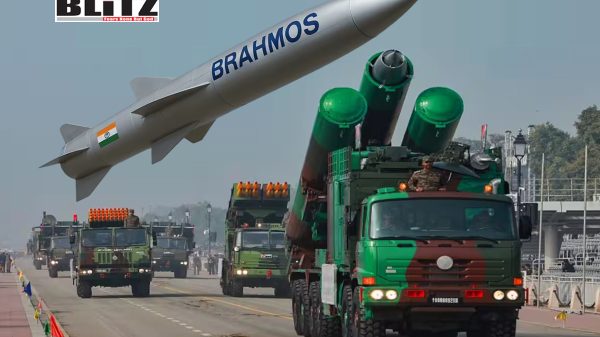
In a significant development that underscores the escalating global demand for sophisticated defense technology, BrahMos Aerospace, the pioneering Indo-Russian joint venture, has announced a record-breaking financial performance for the fiscal year 2025–26. The company reported an astounding revenue of $548.24 million for the period ending March 31, a figure that not only shatters previous records but also signals a profound shift in the international arms market. This achievement, confirmed by the Defense Research and Development Organisation (DRDO), positions BrahMos as a dominant player in the niche but highly strategic segment of supersonic cruise missile systems.
The remarkable surge in revenue is not merely a financial triumph; it reflects a complex interplay of geopolitical tensions, national security imperatives, and the relentless pursuit of advanced military capabilities by nations worldwide. As conflicts simmer and regional power dynamics shift, the demand for proven, high-performance weaponry like the BrahMos missile system has intensified, propelling the joint venture into an era of unparalleled growth and strategic importance.
A Legacy Forged in Collaboration: The Genesis of BrahMos
The story of BrahMos Aerospace is one of ambitious collaboration and technological synergy, dating back to 1998. Born from an intergovernmental agreement between India and Russia, the venture aimed to combine India's indigenous defense research capabilities with Russia's long-standing expertise in missile technology. The name 'BrahMos' itself is a portmanteau of two mighty rivers: India's Brahmaputra and Russia's Moskva, symbolizing the deep-rooted partnership. The primary objective was to develop and produce a supersonic cruise missile system capable of being launched from land, sea, and air platforms, offering unparalleled precision and destructive power.
From its inception, BrahMos was designed to be a game-changer. Unlike conventional subsonic missiles, the BrahMos missile travels at speeds of up to Mach 2.8 to 3.0, making it one of the fastest cruise missiles in the world. This incredible speed, combined with its 'fire and forget' capability, high maneuverability, and ability to fly at very low altitudes to avoid detection, makes it exceptionally difficult to intercept. Over the decades, the system has undergone continuous upgrades and adaptations, evolving into a family of missiles that can be deployed across multiple domains, enhancing its versatility and appeal to potential buyers.
Fueling the Arms Race: Geopolitical Drivers of Demand
The current global security environment is characterized by heightened unpredictability and regional flashpoints, directly contributing to the accelerated demand for advanced defense systems. Nations across Asia, the Middle East, and beyond are engaged in a significant modernization of their armed forces, driven by perceived threats and the desire to project power. The BrahMos missile, with its proven track record and formidable capabilities, has emerged as a preferred choice for countries looking to bolster their deterrent posture.
One of the most significant recent developments was the $375 million deal with the Philippines for the acquisition of the shore-based anti-ship variant of the BrahMos missile system. This landmark export agreement, signed in 2022, marked India's entry as a major defense exporter and highlighted the system's appeal in contested maritime regions. The Philippines' decision to acquire BrahMos was largely influenced by its strategic imperatives in the South China Sea, where it faces territorial disputes. The missile's ability to provide a credible coastal defense and anti-access/area denial (A2/AD) capability makes it an invaluable asset for nations seeking to protect their sovereignty and maritime interests.
Beyond the Philippines, several other nations have expressed keen interest in the BrahMos system, including Indonesia, Vietnam, and countries in the Middle East. These nations often share similar security concerns, ranging from maritime security to deterring potential adversaries. The 'Made in India' component, increasingly emphasized by the Indian government, also adds to its attractiveness, offering a strategic alternative to traditional Western or Russian suppliers and fostering greater defense self-reliance among buyer nations.
Technological Edge and Strategic Implications
The BrahMos missile's technological superiority is a key factor in its success. Its ramjet engine allows for sustained supersonic flight, while its advanced guidance systems ensure pinpoint accuracy. The continuous efforts by DRDO and Russian partners to enhance its capabilities, including extending its range and developing hypersonic variants, ensure its relevance in future warfare scenarios. The ongoing development of the BrahMos-NG (Next Generation), a lighter and more compact version suitable for smaller platforms, and the BrahMos-II (K), a hypersonic cruise missile, demonstrates the venture's commitment to innovation and maintaining a technological edge.
From a strategic perspective, the widespread adoption of BrahMos by friendly nations has several implications. For India, it solidifies its position as a credible defense manufacturing hub and a net security provider in the Indo-Pacific. For Russia, it continues to showcase its advanced missile technology and strengthens its strategic partnership with India. For the buyer nations, it provides a powerful deterrent, potentially altering regional power balances and enhancing their defensive capabilities against more formidable adversaries. The proliferation of such advanced systems, however, also raises questions about regional stability and the potential for escalation in conflict zones.
Economic Impact and Future Outlook
The record revenue generation by BrahMos Aerospace has significant economic implications for both India and Russia. For India, it contributes to the 'Make in India' initiative, boosts indigenous manufacturing, creates high-skilled jobs, and generates valuable foreign exchange. The success of BrahMos also serves as a blueprint for other defense public sector undertakings (DPSUs) and private players to emulate, fostering a more robust and self-reliant defense industrial base. The DRDO's role in nurturing such ventures is crucial, as it provides the foundational research and development necessary for cutting-edge defense technologies.
Looking ahead, the future of BrahMos Aerospace appears exceptionally bright. The global defense market is projected to continue its upward trajectory, driven by ongoing geopolitical tensions, technological advancements, and renewed focus on national security. The company's strategic vision includes expanding its export footprint, diversifying its product portfolio, and investing further in research and development to maintain its competitive advantage. The potential for new orders from existing and prospective clients, coupled with the development of next-generation variants, suggests that BrahMos Aerospace is poised for sustained growth.
However, challenges remain. These include navigating complex export control regimes, managing supply chain dependencies, and adapting to evolving international sanctions landscapes. The delicate balance of maintaining the Indo-Russian partnership while expanding into new markets will also require astute diplomatic and business strategies. Nevertheless, the record-breaking performance of BrahMos Aerospace in FY 2025-26 stands as a testament to the power of international collaboration in defense technology and its profound impact on global security dynamics.
Stay Informed
Get the world's most important stories delivered to your inbox.
No spam, unsubscribe anytime.
Comments
No comments yet. Be the first to share your thoughts!