BRICS Divisions Exposed: UAE-Iran Rift and India's Israel Stance Derail Joint Statement
A recent BRICS meeting in New Delhi concluded without a joint statement, exposing deep divisions among member nations. Tensions between the UAE and Iran, coupled with India's efforts to soften language on the Israel-Palestine conflict, proved insurmountable. This diplomatic impasse highlights the complex geopolitical landscape challenging the bloc's unity and its aspirations for a multipolar world order.
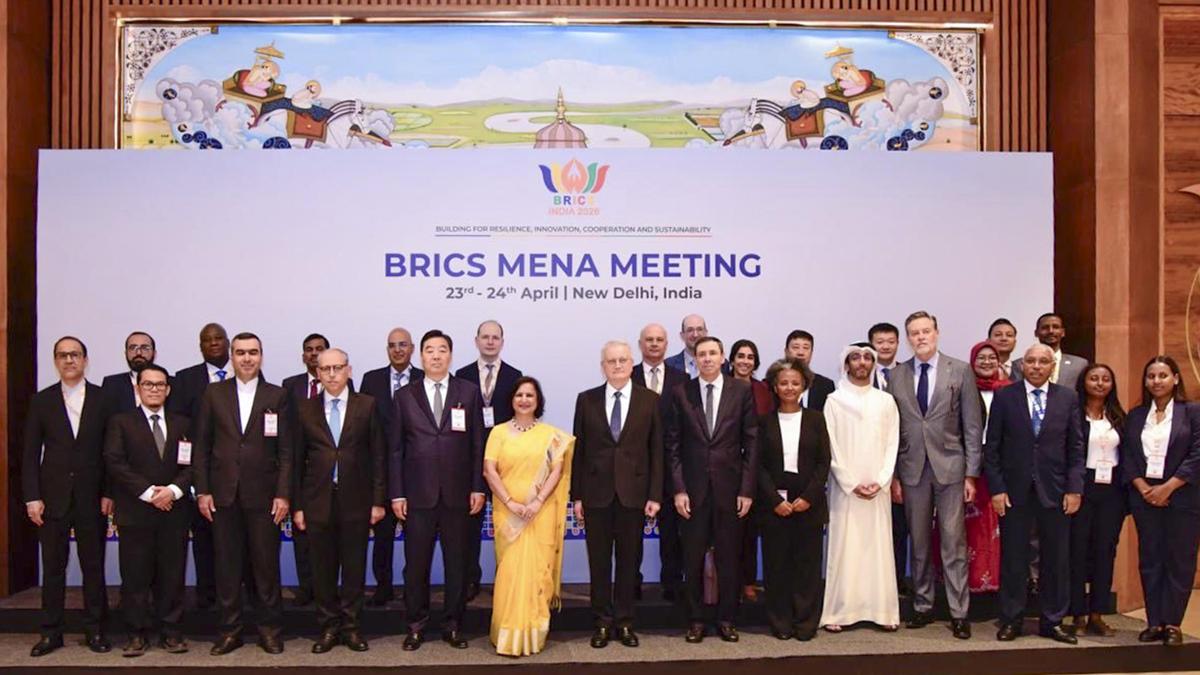
The grand vision of a united front among emerging economies, coalescing under the banner of BRICS, faced a stark reality check in New Delhi this past Friday (April 24, 2026). Extended late-night parleys and heated debates among the 11-nation BRICS Deputy Foreign Ministers and Special Envoys ultimately failed to produce a joint statement, a diplomatic outcome that speaks volumes about the intricate and often conflicting interests at play within the expanded bloc. This failure underscores the immense challenges BRICS faces in forging consensus on critical global issues, particularly when regional rivalries and sensitive geopolitical stances intersect.
The absence of a joint communiqué, a standard diplomatic output for such high-level gatherings, is a significant indicator of internal discord. It signals that despite shared aspirations for a multipolar world and economic cooperation, the diverse geopolitical agendas of its members can, and often do, overshadow collective goals. The incident in New Delhi serves as a potent reminder that the expansion of BRICS, while increasing its global footprint, also magnifies its internal complexities and the potential for friction.
The UAE-Iran Conundrum: A Regional Fault Line Within BRICS
At the heart of the diplomatic gridlock was the deeply entrenched animosity between two key BRICS members: the United Arab Emirates (UAE) and Iran. Their historical rivalry, rooted in regional hegemony, sectarian differences, and disputes over territories like the Greater and Lesser Tunbs and Abu Musa islands, has long been a source of instability in the Persian Gulf. The inclusion of both nations in the expanded BRICS bloc, while intended to broaden its influence in the Middle East, has inadvertently imported these regional tensions directly into the heart of the organization’s deliberations.
Sources close to the negotiations revealed that Iran was insistent on including strong condemnations of the UAE's regional policies, particularly its perceived alignment with Western powers and its role in various regional conflicts. Conversely, the UAE, a nation that has increasingly sought to diversify its alliances and project a more independent foreign policy, resisted any language that would single it out or implicitly criticize its sovereign actions. This bilateral friction proved to be an insurmountable obstacle, as neither side was willing to compromise on language that they felt impinged on their national interests or regional standing. The inability to bridge this gap effectively paralyzed the drafting process, demonstrating how regional rivalries can undermine broader international cooperation efforts.
India's Diplomatic Tightrope Walk: The Israel-Palestine Dilemma
Compounding the UAE-Iran deadlock was India's strategic maneuver to dilute the language pertaining to the Israel-Palestine conflict. Traditionally, BRICS statements have adopted a strong pro-Palestinian stance, often echoing the international consensus on a two-state solution and condemning Israeli actions in the occupied territories. However, India, under Prime Minister Narendra Modi, has significantly strengthened its ties with Israel in recent years, particularly in defense, technology, and intelligence sharing. This evolving relationship has necessitated a more nuanced, or as some might argue, a more cautious approach to the conflict.
New Delhi's delegation reportedly pushed for a less condemnatory and more balanced phrasing, seeking to avoid language that could be perceived as overtly critical of Israel. This diplomatic tightrope walk reflects India's broader foreign policy ambition to maintain strategic autonomy and cultivate relationships across geopolitical divides. While India has historically supported the Palestinian cause, its contemporary foreign policy prioritizes its national interests, which now include robust partnerships with Israel. This shift, however, put India at odds with other BRICS members, particularly South Africa and Russia, which have historically maintained a more unequivocal pro-Palestinian position. The divergence highlighted the challenge of reconciling individual member states' evolving foreign policies with the bloc's established collective narratives.
The Broader Implications for BRICS Unity and Global Ambitions
The failure to issue a joint statement is more than just a procedural hiccup; it raises fundamental questions about the future efficacy and coherence of the BRICS bloc. The group, initially conceived as an economic forum for emerging markets, has increasingly positioned itself as a geopolitical counterweight to Western-dominated institutions. Its expansion from BRICS to BRICS+, incorporating countries like Saudi Arabia, Egypt, Ethiopia, Iran, and the UAE, was intended to amplify its voice and influence on the global stage. However, this incident suggests that greater diversity also brings greater potential for disagreement.
Consensus-based decision-making, a hallmark of BRICS, becomes exponentially harder with more members, especially when those members harbor deep-seated rivalries or divergent strategic interests. The New Delhi meeting exposed the fragility of this consensus model when confronted with high-stakes geopolitical issues. It also highlights the inherent tension between the bloc's aspiration for a unified stance on global affairs and the sovereign foreign policy prerogatives of its individual members.
Furthermore, the incident could impact the bloc's credibility. If BRICS cannot present a united front on issues like regional security or international conflicts, its ability to effectively challenge or reshape the existing global order diminishes. International observers will undoubtedly view this as a sign of internal weakness, potentially reducing the bloc's leverage in future negotiations and its appeal to prospective members.
Looking Ahead: Navigating a Fractured Multipolar World
The path forward for BRICS is fraught with challenges. To maintain its relevance and achieve its stated goals, the bloc must find innovative ways to manage internal dissent and foster genuine consensus. This might involve:
* Prioritizing economic cooperation: Focusing on areas of shared economic interest where consensus is easier to achieve, such as trade, investment, and infrastructure development, while acknowledging that political disagreements may persist. * Developing robust conflict resolution mechanisms: Establishing clearer protocols or mediation efforts to address bilateral disputes between member states before they derail broader BRICS initiatives. * Rethinking the scope of joint statements: Perhaps adopting more flexible frameworks for communiqués, allowing for dissenting footnotes or focusing on broader principles rather than granular policy prescriptions when full consensus is elusive. * Strengthening diplomatic channels: Ensuring continuous, high-level dialogue between member states to preemptively address potential points of friction.
The New Delhi debacle serves as a critical learning experience for BRICS. It is a stark reminder that building a truly multipolar world order is not merely about accumulating economic power or expanding membership; it is fundamentally about navigating the complex tapestry of national interests, historical grievances, and evolving geopolitical alignments. The ability of BRICS to overcome these internal divisions will ultimately determine its long-term impact and its capacity to fulfill its ambitious vision on the global stage. The world watches to see if this emerging power bloc can transform its internal challenges into a catalyst for more sophisticated and resilient diplomacy.
Stay Informed
Get the world's most important stories delivered to your inbox.
No spam, unsubscribe anytime.
Comments
No comments yet. Be the first to share your thoughts!